
Showroom costs: planning a realistic budget for construction and running costs
- Showroom

Corporate showrooms are like so many things: at first glance, you usually can’t tell what they’re really made of – or, consequently, how much they cost. After all, interactive corporate showrooms are more than just a collection of displays. When all the elements work together, the result is a kind of living space with its own narrative. A walk-in brand essence, so to speak.
Against this backdrop, this article aims to break down the important issue of costs and outline rough budget ranges. To do this, project managers need, above all, an understanding of the (initially hidden) cost drivers and a sense of where savings can be made – and where it is better not to. We are referring specifically to permanent corporate showrooms, not to those used in trade fair stand construction or other temporary installations.
How much does a corporate showroom cost? A small, professional showroom usually costs between 150,000 and 300,000 euros net. For a medium-sized showroom with bespoke interactive installations, companies should budget for around 300,000 to 600,000 euros. Large-scale corporate exhibitions or innovation centres usually start at 600,000 euros. The actual costs depend primarily on the size of the space, the interior fit-out, media technology, software and content.
First things first: develop the basic concept
Before the budget for a corporate showroom can be estimated, it must first be clear what the space is intended to achieve. During the concept development phase, Garamantis therefore begins by analysing the target audiences, content, visitor flow and overarching concept, as well as the spatial and technical constraints. Building on this, we develop a concrete implementation concept comprising visualisations, technical planning and the project plan. For companies, this is usually the basis for evaluating the project internally and ultimately going ahead with it.
Good planning may well save you from making costly mistakes. If it is clarified at an early stage which stations are actually needed, what content is already available, where standard solutions are sufficient and where a bespoke demonstrator or a special technical installation makes sense, the budget for the showroom itself can also be determined more precisely. This also makes subsequent changes to the cabling, furniture or other elements less likely.
Concept development is essential for minimising risk and is therefore the first, fundamental step towards setting up your own showroom and planning its costs. We have therefore listed the key questions again below.
You will need these 7 details for an initial concept development and a realistic budget estimate
- Which business areas is the room intended to serve: Sales, Corporate Communications, Innovation, Recruitment, or several at once?
- Who are the key target groups? Investors, existing customers, new customers or staff?
- How much space is available, and what are the structural constraints? (Floor recesses, suspended ceilings, escape routes, acoustics, etc.)
- What content (3D models, promotional videos, diagrams, etc.) is already available, and what needs to be produced from scratch?
- What proportion should be allocated to analogue elements, such as the product display, and what proportion to interactive installations and bespoke software?
- How will the space be used in future – primarily for occasional guided tours, regular visitor groups, or might it even end up being open all the time? Should it be explored independently or only as part of a guided tour?
- How much of a ‘wow factor’ is appropriate for the location? Is it a production facility, an innovation centre or even the company’s head office?
The more precisely you answer these seven points, the quicker you can turn a rough idea into a concept and, in turn, a reliable budget estimate.
How much does concept development cost?
Concept development usually costs around five to ten per cent of the subsequent total budget and takes approximately three months, depending on the scope of the project and the pace of coordination. The total budgets set out below include the concept and planning services commissioned separately beforehand. The concept costs are not credited retrospectively, but form part of the total investment volume shown.
The concept development comprises the creative core idea, floor plan and visitor journey, visualisations, technical planning, cost estimate and project plan. This provides the company with all the information it needs to make an internal decision. The agreed rights of use are transferred to the company, which can then have the showroom built by a service provider of its choice.
In the case of a full-service implementation by Garamantis, the budget and launch date are set in stone once the concept phase has been completed.
Which cost components come into play in a corporate showroom?
Once the concept has been developed and approved, the actual implementation begins. A corporate showroom usually comprises several areas that must be closely coordinated: the fit-out and interior design, media technology and hardware, bespoke software, the design, and the content and exhibits. Added to this are project management and on-site commissioning. This breakdown is important for budget planning because each area involves its own costs – and changes in one area almost always have an impact on others.
So anyone planning a showroom should not just think about the technical equipment, but also about the overall architecture of the project:
- As mentioned above, the first stage is the concept. Here, we define the target audiences, objectives, visitor flow, a storyline and the interactive stations to be used. Building on this, we carry out the technical planning, which covers all media technology and IT hardware.
- The second section covers interior design. This includes interior fit-out, comprising drywall, finishes, furniture, any bespoke fixtures, electrical work, lighting, etc.
- In the third section, we look at the specific software that brings all the elements together – often the most underestimated part. The software is controlled by sensors in the room, but also actively via touch, voice, tablets or other media. It is responsible for the actual presentation of the company and its products.
- The fourth section comprises the content on display: text, (moving) images, 3D content, design, animations and visualisations. All digital content is managed by a central content management system, which allows for rapid changes at any time.
- The fifth phase covers integration, commissioning, testing and the necessary project management.
Why the costs of corporate showrooms vary from case to case and why prices per square metre are only a rough guide
First of all, let’s get one thing straight: many project managers believe that the size of the showroom is the most important factor. However, the costs depend only partly on the floor space used: a 100-square-metre room with two simple media stations is a completely different proposition to a 100-square-metre room with several bespoke installations, LED screens and customised software and control systems. A more important question is how sophisticatedly the elements mentioned above are co-ordinated and, consequently, how complex the system becomes. After all, one thing is clear: hanging up a few screens and playing PowerPoint presentations on a continuous loop is a quick job. But the result would be rather dull and the exact opposite of a ‘wow’ factor. You only make a lasting impression when you guide your visitors with well-thought-out and interactive formats, dramatic lighting control and clever audio elements. Nevertheless, prices per square metre can initially serve as a way of estimating the target costs, as we demonstrate using the example of interior fit-out.
The concept is in place – so how much does the interior fit-out of a corporate showroom cost?
As already mentioned, interior fit-out constitutes a separate cost category and should initially be considered separately from technology, software and the content on display. As a rough guide: if a suitable space is already available, the cost of the refurbishment can initially be estimated per square metre as follows. For example, a conventional refurbishment costs between 400 and 900 euros net per square metre, whilst a high-quality fit-out using appropriate materials can sometimes cost between 900 and 1,800 euros per square metre.
Costs arise primarily from creating the conditions for lighting, acoustics, wall and ceiling finishes, flooring, and shopfitting or interior fit-out. Lighting alone can easily run to a five-figure sum, as the budget must cover not only the luminaires themselves but also the lighting design, control systems and installation. For flooring, a rough estimate of 30 to 150 euros per square metre can be assumed. Plasterboard walls often cost between 40 and 80 euros per square metre, whilst ceilings, depending on the design, generally cost between 40 and 120 euros per square metre. In shopfitting, simple solutions often start at around 100 to 200 euros per square metre, whilst high-quality fixtures tend to be significantly more expensive. The construction of display units, for example for a product exhibition, must also be taken into account, as display cases, plinths, mountings and lighting are usually made to order.
In practical terms, this means that even the room itself – without any technology or content – represents a cost factor that should not be overlooked.
Why it is important to distinguish between capital expenditure and running costs
In order to estimate the budget realistically, capital expenditure (CAPEX) and ongoing operating costs (OPEX) should be clearly separated. Capital expenditure, for example, covers all stages from the initial concept, through design and development, to the creation and integration of content and commissioning. This is the obvious part of the budget.
What internal costs should companies factor into their budgets?
In addition to external project costs, there are also internal costs incurred by the company. These primarily include project management and coordination between the departments involved, the provision and approval of content, and the involvement of IT, procurement and facilities management. In the case of international showrooms, translation work and additional approval processes are often required. Even after the opening, sufficient staff should be allocated to organise visitor groups, guided tours and events.
What are the running costs associated with corporate showrooms?
In addition to hosting, licences, IT administration and support, cleaning, security, energy consumption, maintenance, repairs and replacement equipment should also be taken into account. Added to this are staff for guided tours and organisation, catering, transport, consumables, as well as the regular updating and translation of content. In the long term, major software updates and the replacement of obsolete hardware may also become necessary.
The actual operating costs depend primarily on the technical equipment, opening hours, visitor numbers and the desired scope of services. It is therefore important to clarify, as early as the concept phase, who will operate the showroom, manage its content and resolve any technical faults.
We recommend keeping monthly fixed costs as low as possible and contract terms flexible – though there should be easily accessible support and clear lines of responsibility.
For large and complex projects, it also makes sense to build in a contingency. In the construction industry, it is common to allow for unforeseen expenditure of between five and ten per cent to cover for unforeseen circumstances. The good news is: once the concept development phase has been completed, along with the corresponding time and cost planning, Garamantis assumes the project risk. For you, as the project manager, this means there is a fixed budget and a fixed opening date!
Five money-saving tips: Where you can make sensible savings on a corporate showroom
- A well-thought-out concept: The greatest potential for savings lies in planning wisely and comprehensively right from the start. Those who know how to set their priorities can make savings in many areas later on. It is often more cost-effective to invest heavily in a few key displays (the centrepiece) rather than scatter many rather mediocre exhibits throughout the showroom. The concept is the linchpin for determining where every euro spent can achieve the maximum impact for the company.
- A phased approach:With showrooms in particular, the value to the company often only becomes apparent once you are standing in the finished space. It is therefore perfectly reasonable to start with a simplified basic version and develop it further later on. The key thing is that the basic version already conveys a clear vision and does not come across as a stopgap. Furthermore, the concept should already outline possible stages of development, so that, for example, the company can plan ahead with regard to structural alterations to the space.
- Focus on content and experiences: Interactive corporate showrooms should always focus on the content rather than placing too much emphasis on making a grand impression. A content management system (CMS) that makes it easy to change content and tailor it to different target audiences is of key importance here. A well-thought-out, bespoke story for each target audience does not have to be expensive.
- Making a conscious effort to save on AV media and hardware: An experience can be staged with varying levels of technical complexity. In the simplest case, a screen wall can consist of a single 95-inch 4K screen. At a medium level, this can become a 2x3 wall. And in the premium version, it becomes a large-format LED wall that offers good resolution even at close viewing distances. The experience can nevertheless be similar in all three cases. It is precisely for this reason that good planning right from the start is crucial.
- In-house work during implementation:Companies often have trusted local partners to carry out parts of the implementation themselves. Typical tasks that can often be carried out by the company itself in an unbureaucratic and cost-effective manner include: drywall installation, tiling, electrical work and interior fit-out.
Spatial elements and scaling options: from small and clever to the ‘wow’ factor
Room element
Basic solution
Mid-range
Premium solution
Wall display
High-quality wall print with a subtle play of light
Projection or a single large screen
interactive projection or multi-touch wall
Lighting
individual smart LED spotlights
Centralised lighting control
An interactive lighting concept as part of the dramatic structure
Sound
a good stereo system
5.1 system for guidance and staging
Interactive 3D audio concept
Interactive main station
suspended multi-touch screen
Multitouch table
Networked multi-touch installations with a screen wall and CMS
Display cabinet
Classic display cabinet plus tablet
Display cabinet with a partially transparent monitor
Interactive display case with a clear glass effect and integrated media functionality
Product presentation
physical exhibit
physical exhibit plus digital explanation
interactive, holistically staged product presentation
Model / Exhibit
analogue model
illuminated or sensor-enhanced model
Model with interactive projection mapping
Screen Wall
a single 95-inch 4K screen
2x3-screen wall
LED wall with a tight pixel pitch
Glass front
Film lamination
Sections with LED film
large-scale, high-resolution media integration
Three budget categories for corporate showrooms
Based on this, our experience suggests that it is possible to initially categorise projects into three broad budget categories. For a small but professional showroom featuring a central multi-touch table, a screen wall, a small product display, and controlled lighting and audio, we generally work within a budget range of between 150,000 and 300,000 euros net. For a medium-sized showroom with bespoke installations (serving as highlights or centrepieces) covering around 100 square metres, the cost is usually between 300,000 and 600,000 euros. And a complete corporate exhibition or an innovation centre at the company’s headquarters often exceeds 600,000 euros. In principle, these costs can be taken as a guide for a full-service project where the space is already fundamentally fitted out (ceiling, walls, floor, lighting, electrical systems).
- A starting salary of between 150,000 and 300,000 euros
In the entry-level budget category, it is important to focus the content and elements on the essentials. This means having a good concept that prioritises a practical digital presentation whilst keeping costs down on the interior fit-out. Typical features include a strong, interactive main station, a manageable amount of content and a space that is deliberately designed to be practical yet high-quality. This alone can be very persuasive – especially when the touch table, screen wall, lighting and audio work together seamlessly. This budget is also well spent by small and medium-sized enterprises in the B2B sector to win over their target audiences.
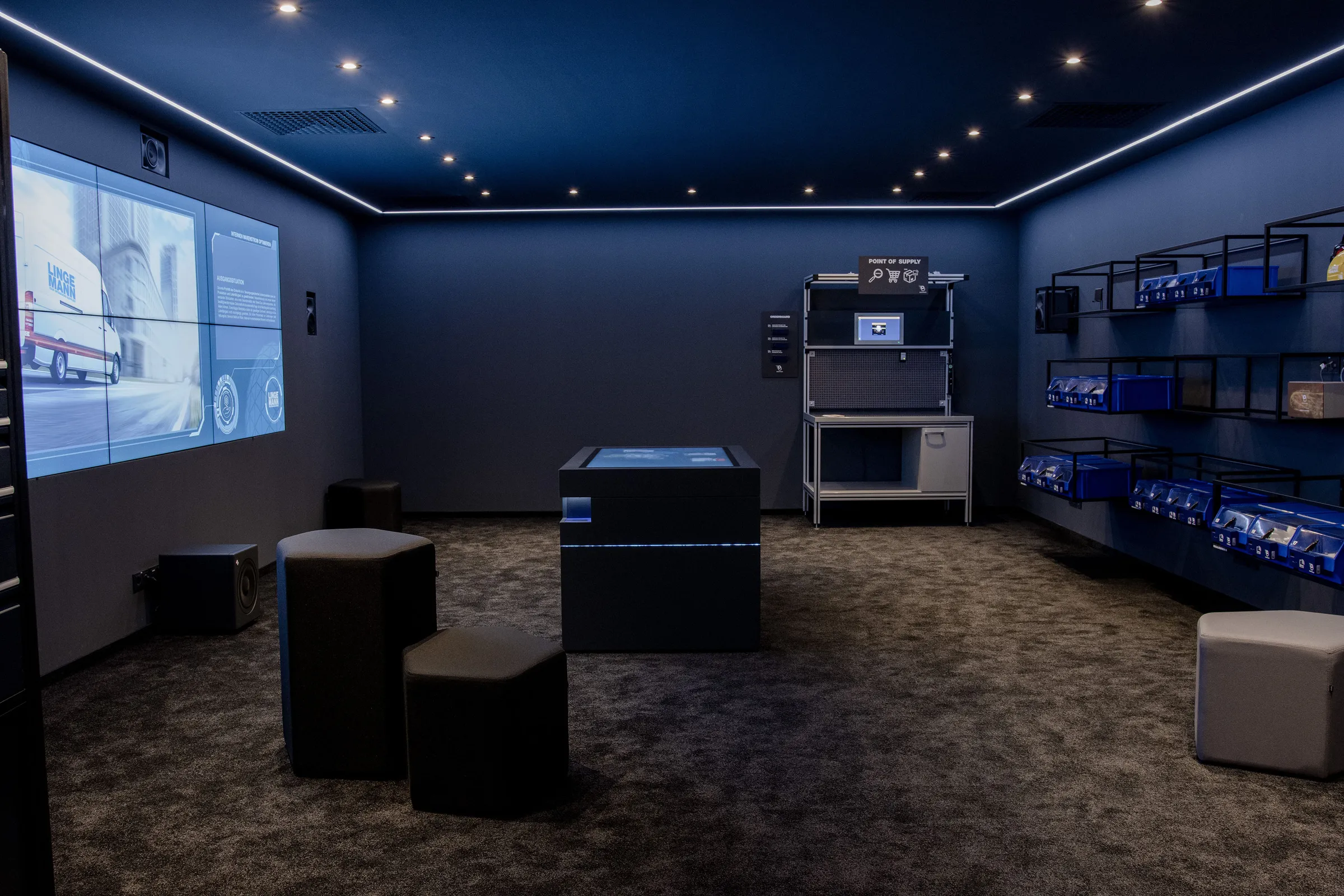
One example of this is Lingemann GmbH’s ‘Procurement Future’ showroom, which covers an area of around 55 square metres. At its heart is a multi-touch scanner table, which is linked to a screen wall as well as the lighting and audio control systems. This allows complex topics relating to modern procurement and digitalisation to be clearly conveyed using just a few, well-coordinated elements.
- A bespoke room costs 300,000 euros and upwards
In the mid-range price bracket, showrooms become significantly more bespoke. Consequently, concept development is more demanding. In addition to traditional presentation tools, specially developed highlight installations are often incorporated to serve as centrepieces. These may include, for example, hologram installations or elaborate live demonstrators. The display areas are also generally designed with greater attention to detail to achieve specific effects. Exhibits become more elaborate and form part of the spatial design. In our experience, this is often the most economically attractive category for most companies – here, showrooms create genuine brand experiences.
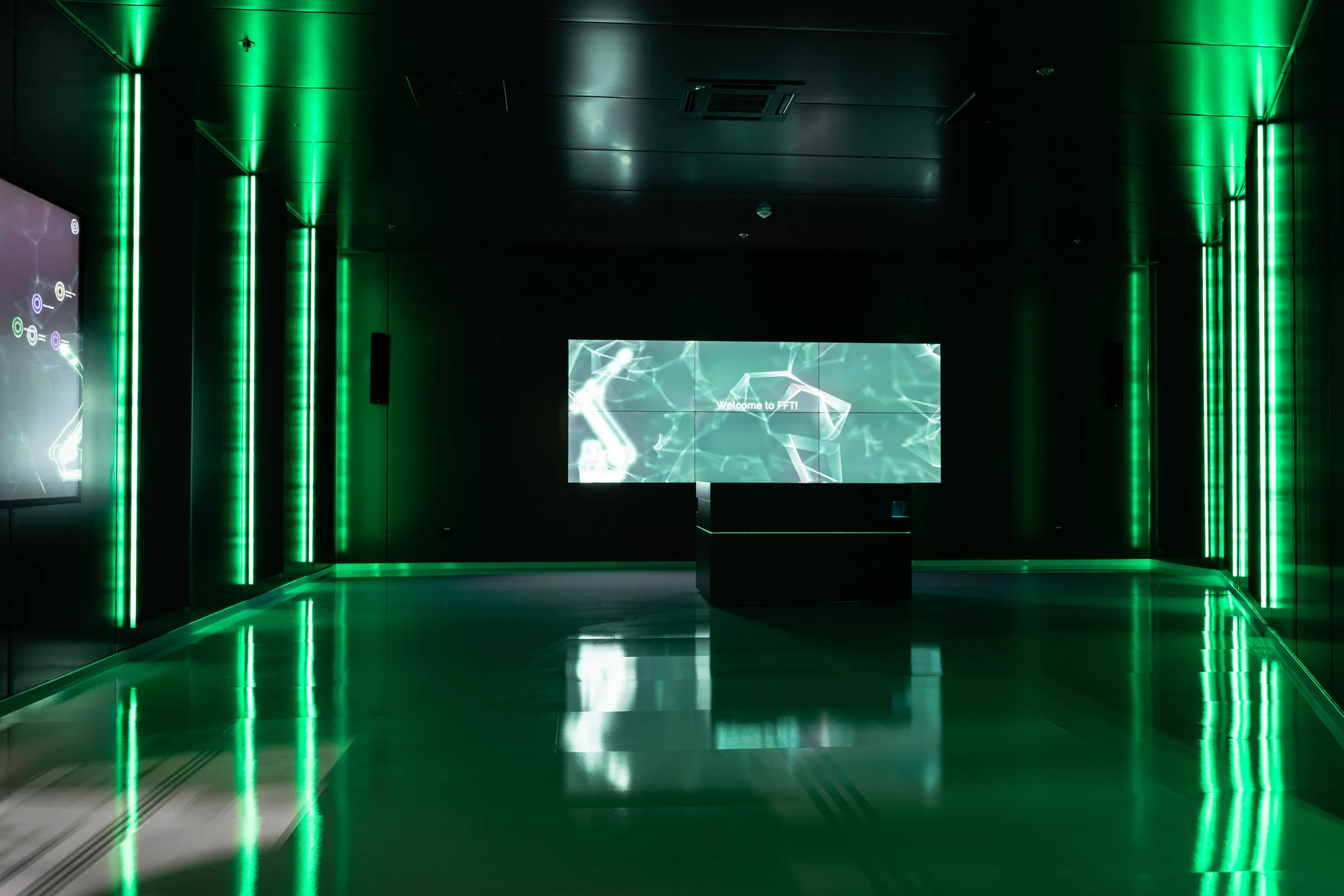
One example is the FFT Produktionssysteme showroom in Fulda. There, we combine a multi-touch scanner table with a large-format screen wall, a customisable lighting installation featuring around 3,000 LEDs, and a specially developed audio and control concept. The whole experience is complemented by real production demonstrators, augmented and virtual reality applications, and a presentation structure tailored to different visitor groups.
- Fancy a flagship model? Our showrooms start from 600,000 euros
At this scale, we are talking about a showroom that transforms an entire brand into an experience and meets the requirements of a corporate group. They usually consist of several zones or rooms featuring sophisticated displays. All the elements within the space are perfectly coordinated and, taken together, create an impressive and lasting experience – even for international guests and delegations.
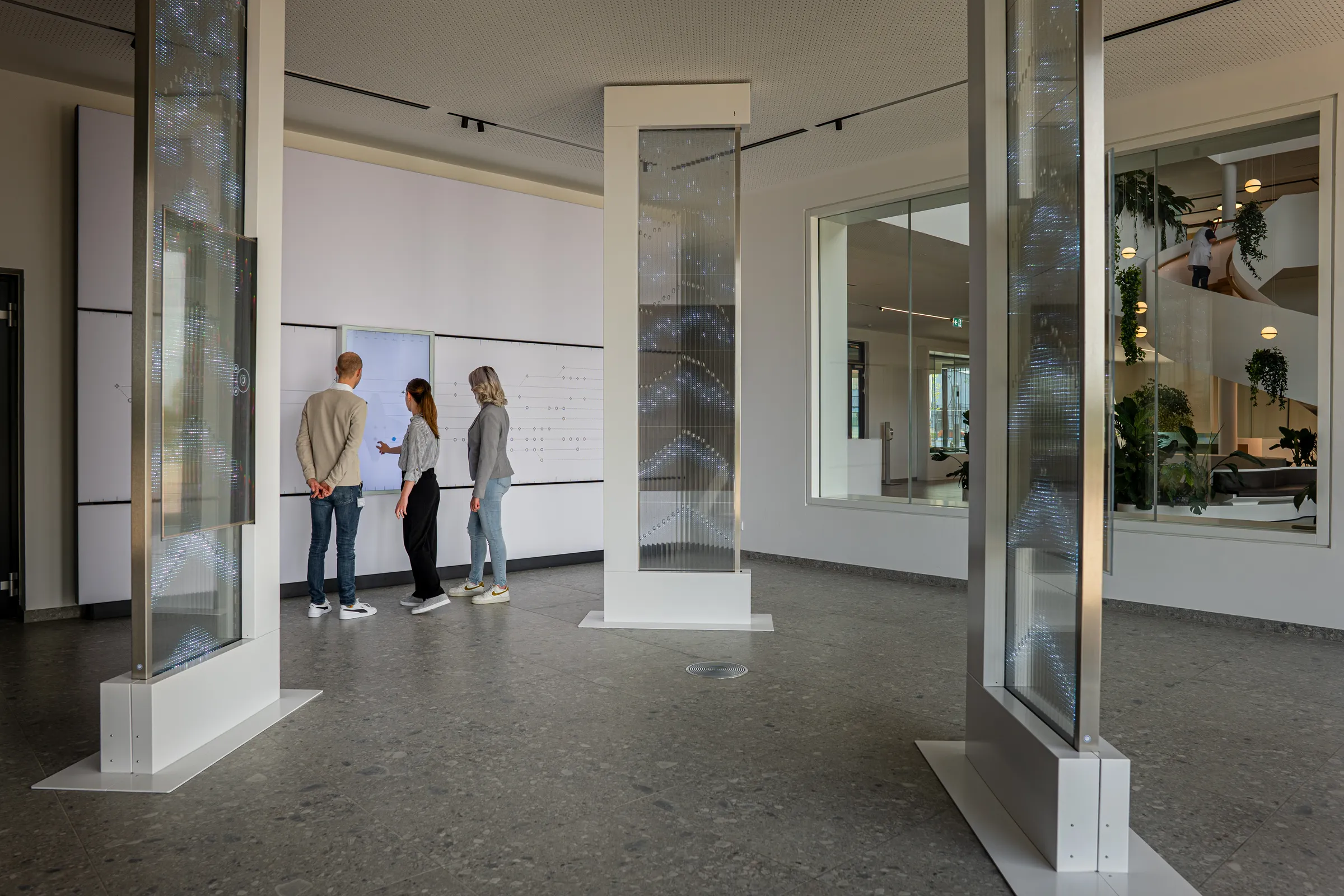
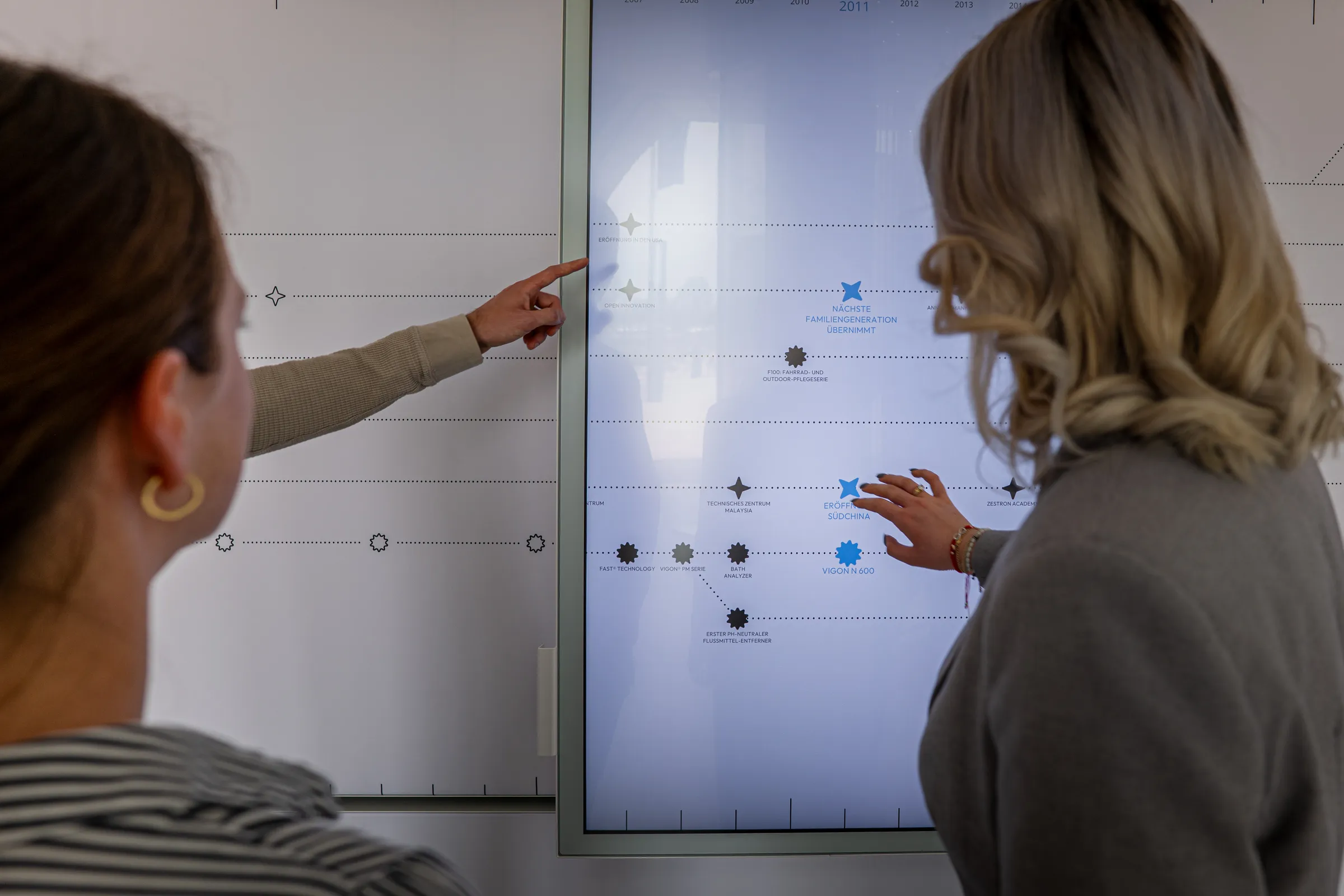
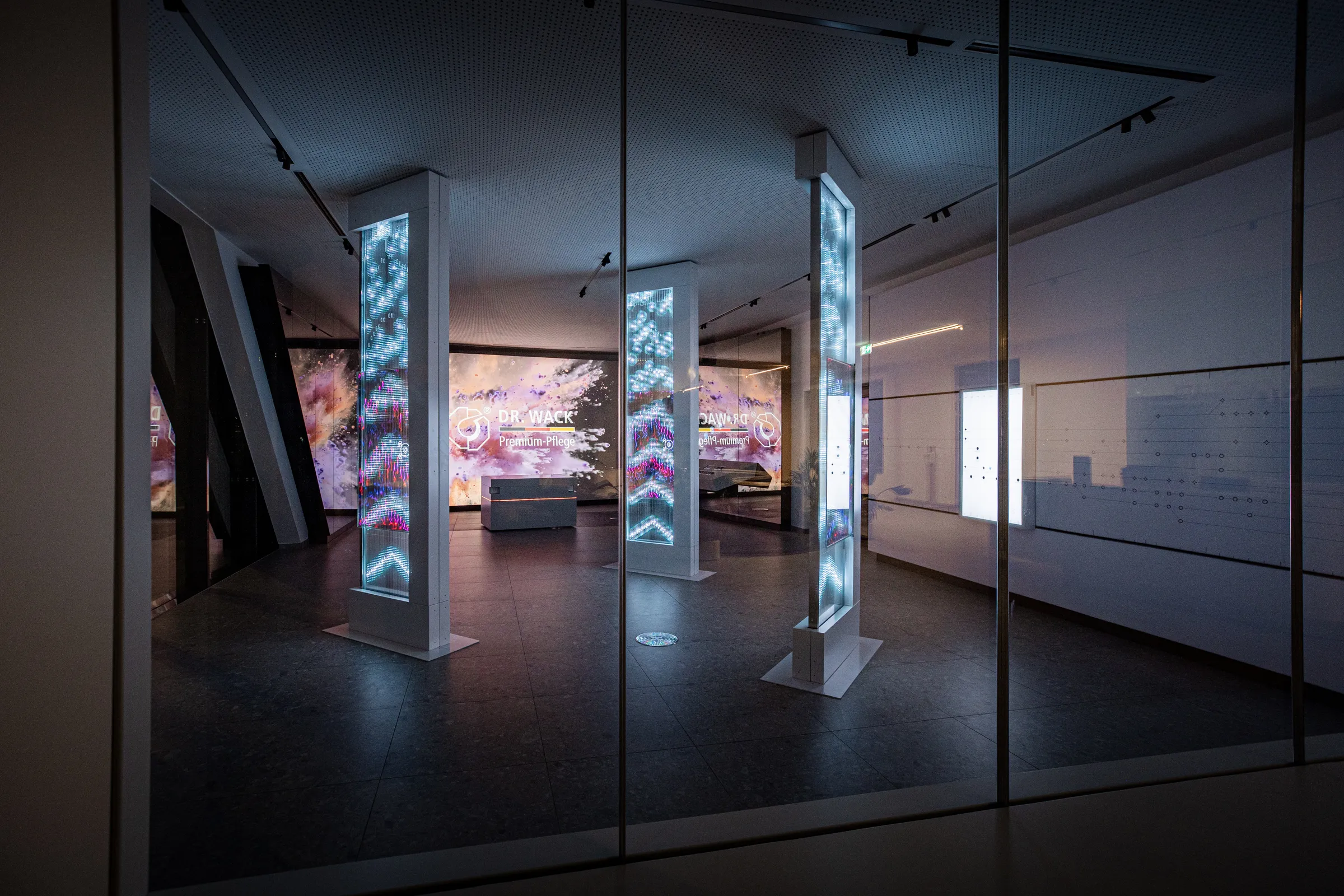
One example of this is the Wack Group’s corporate showroom at its headquarters near Ingolstadt. Four individual interactive stations guide visitors through the company’s history and its various product ranges. At the heart of the display are three specially developed 3-layer displays that combine an LED film, a glycerine layer and transparent OLED touchscreens. These are complemented by an interactive History Wall, specialised sensor technology and a central control system through which two brands can be showcased. The result is a cohesive customer journey that brings the Wack Group’s pioneering spirit to life.
Sample overall cost estimate for a corporate showroom
For an existing room measuring around 100 square metres and with a medium level of fit-out, the total budget is typically between 300,000 and 600,000 euros.
Cost section
Proportion
At €300,000
At €600,000
Concept and planning
5 per cent
€15,000
€30,000
Interior fit-out
15 per cent
€45,000
€90,000
Media technology and hardware
30 per cent
€90,000
€180,000
Software and CMS
20 per cent
€60,000
€120,000
Content creation and management
15 per cent
€45,000
€90,000
Integration and commissioning
5 per cent
€15,000
€30,000
Project Management
10 per cent
€30,000
€60,000
Total
100 per cent
€300,000
€600,000
This breakdown is provided for guidance only. Depending on the project, interior fit-out, technical systems, software or content may account for a significantly larger proportion.
Five common mistakes in cost calculation
Errors in cost planning can be avoided by taking a sensible approach. We have therefore listed the five most common mistakes – based on our experience – here once again:
- The first mistake is to talk about hardware too early and about the actual objectives too late. If the target audiences, the content-related objectives and the role of the space are not clarified in advance, the result is often a space that appears impressive at first glance but is lacking in meaningful content and has little long-term value.
- The second mistake is to underestimate the role of the software and the CMS. In high-quality showrooms, it is not merely an accessory, but the central system that brings the company’s content and products to life in an interactive way.
- The third mistake is to dismiss digital content as secondary as well. This, too, needs to be structured, visualised, tested and, later on, optimised and maintained. Even the most impressive display screen is of little use if it is simply being used to play a PowerPoint presentation.
- The fourth mistake is trying to reach multiple target audiences with the same content. Whilst this may initially seem to save effort in the planning and creation of content, it ends up backfiring. A corporate showroom should therefore have several content presets for different target audiences, as well as non-linear – that is, spontaneous – ways of tailoring the content to visitors.
- The fifth mistake is failing to take day-to-day operations into account right from the start. A showroom is not a one-off project, but an ongoing process within the company. Its measurable contribution to turnover and profit should therefore be continually optimised.
An option sooner or later: modernising an existing showroom
Although we have so far focused primarily on new showrooms in this article, it is worth taking a brief look at how existing showrooms can also be upgraded at relatively low cost. Not every old showroom needs to be completely rebuilt. If the basic structure and fabric are still sound, a targeted update may be sufficient: new software, interactive sensors, revised content, new media technology, a controllable lighting concept or the refurbishment of key highlight areas. Companies are often becoming more digital, and the corporate showroom must reflect this. Alternatively, the space may have been in use for many years and the technology may no longer be up to date – for example, because it is too linear and lacks interactivity. Here, too, the concept is crucial: which existing elements can be retained and which should be replaced?
Conclusion: Good showrooms cost money. Bad decisions cost you your nerves, time and even more money.
An interactive corporate showroom is a strategic investment. It should not only look good, but also make complex content easy to understand, bring innovations to life and impress visitors. The most sensible way to save money is therefore not to cut individual components, but to ensure a sound concept right from the start. Those who prioritise clearly at an early stage, set objectives, use media effectively and take future operations into account will achieve a successful and, in the truest sense of the word, cost-effective showroom more quickly.